Sustainability Begins on Westtown School’s 600-Acre Campus
At Westtown School, sustainability isn’t an add-on—it’s a way of learning and living that starts early, outdoors, and in relationship with the natural world.
At Westtown School, sustainability is not a single unit in science class or a poster on a classroom wall. It’s a lived practice that is woven into how students learn, how they relate to one another, and how they come to understand their place in the world.
As a Quaker, pre-K–12 day and boarding school, Westtown is guided by a mission that calls its community to seek and honor the Light in each person, nurture individual gifts, and prepare graduates to be stewards and leaders of a better world. That mission is articulated across the school’s academic, community, and environmental commitments, and is reflected deeply in Westtown’s Sustainability Plan, which recognizes that the health of the natural systems that support all life is inseparable from the health and well-being of students.
“Westtown’s Sustainability Plan weaves health and education into a single pillar, acknowledging that a student’s ability to thrive is inextricably linked to the health of the natural world and one’s own wellbeing” says Francine Locke, Westtown’s Director of Sustainability. “Sustainability is more than a lesson in a textbook, it is a foundational commitment to nurturing both the individual and the natural systems that support all life.”
That pillar—Health & Education—sets a campus-wide intention: sustainability should be visible in daily experiences, across disciplines, and across the developmental arc of childhood. It reflects Westtown’s belief that some of the most powerful learning happens when students move beyond information and into relationship with the world.
A Campus That Teaches
Westtown’s 600-acre campus (click for virtual tour), comprising woods, creeks, open fields, and farm spaces, makes it possible to turn stewardship from an abstract value into something students can practice, measure, and feel.
“Our 600-acre campus allows teachers to transform stewardship as a concept into practice,” Locke explains. “These natural settings allow teachers to shape abstract ideals of care and responsibility into tangible daily habits.”
She points to examples across ages. “Responsibility becomes an active pursuit when Lower School students nurture the soil in their ‘Three Sisters’ garden. Middle School students provide fresh harvests via hydroponics, and Upper School students quantify climate change impacts through measuring their observations of trees in our forest. These experiences teach students that sustainability is measurable and that a school can—and must—model a world that honors the systems supporting all life.”
In Locke’s view, sustainability is not confined to one program or one grade—it becomes a way of thinking.
“Sustainability is a lens through which students view every discipline, from math to world languages,” she says, describing how students might map population density against market access to explore food deserts in math, or apply creative problem-solving to environmental challenges through global perspectives in language study.
That lens is especially powerful when it starts young—before children learn to separate “school” from “life,” or “nature” from “people.”

Farm & Forest: Science, Wonder, and Careful Noticing
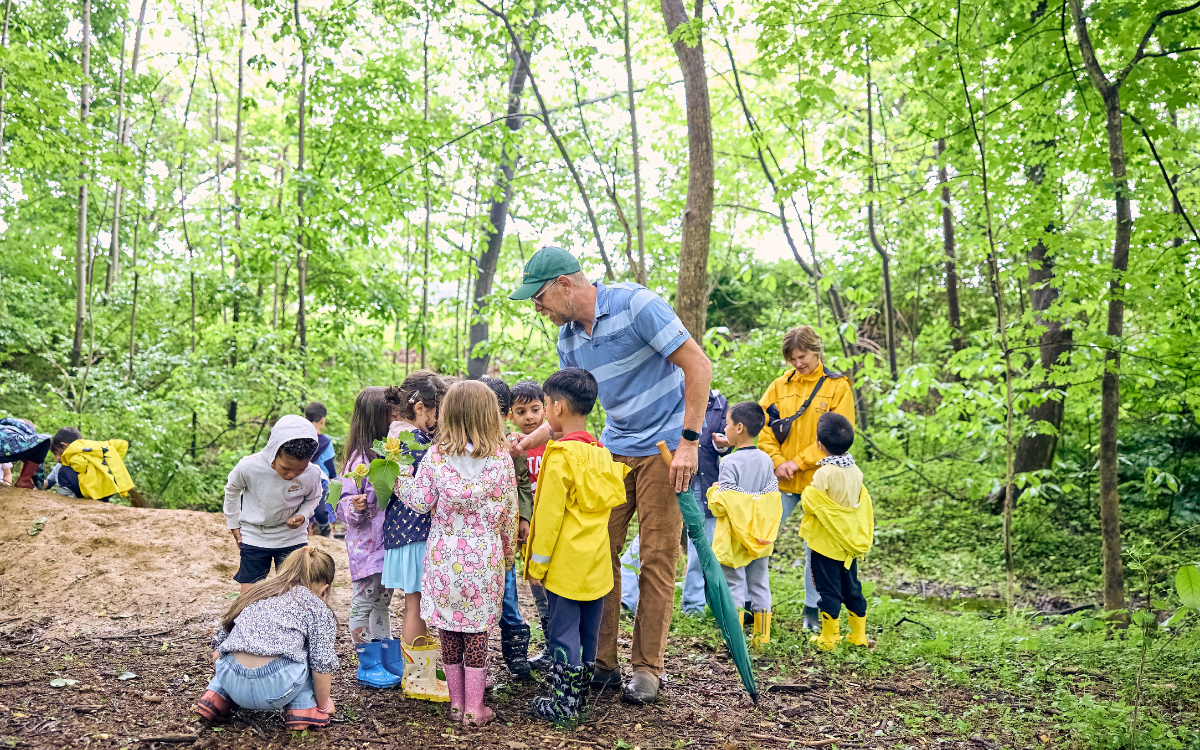
For Westtown’s youngest students, sustainability is introduced through direct experience. The Farm & Forest Program (video link) is Westtown’s outdoor, place-based science program for Pre-K, kindergarten, and first grade students, designed to help children develop a connection to the natural world through hands-on exploration, careful observation, and sensory awareness.
The program is co-led by Chris Henwood-Costa, Westtown’s Director of Outdoor Education, and Tim Mountz, known affectionately on campus as “Farmer Tim,” Westtown’s Sustainable Agriculture Educator and Farm Manager.
Farm & Forest happens in all seasons: rain, snow, or shine. Students explore woods and fields, study tree identification and life cycles, moss, lichen, and fungi, deer tracking, composting, winter survival strategies, maple sugaring, pollinators, spring planting and tasting, vernal pools, and water ecosystems.
But the deeper curriculum is less about content delivery and more about cultivation.
“It’s really helping them to cultivate that sense of observation,” Henwood-Costa says. “And not just with your visual sense, but observation with your being.”
Observation isn’t limited to looking closely. It includes smelling a leaf, noticing a shift in the wind, or hearing a sound and asking where it’s coming from—learning that attention itself is a skill.
Mountz sees this work as a counterbalance to an increasingly fast-paced world. “If you don’t know how to make a great observation, someone’s going to give you a phone and you’re going to miss out on asking big questions,” he says. “It’s a little bit like the difference between knowledge and wisdom. And I don’t think you’re getting a lot of wisdom from the Internet. You’ve got to get that from elders and people that have lived experiences.”
Farm & Forest helps young children practice how to learn: how to wonder, how to question, and how to stay present long enough for understanding to deepen.
Spring: When the Campus Wakes Up—and Children Do, Too
In spring, Westtown’s campus becomes an active teaching partner. Familiar places transform as snowdrops and aconite flowers emerge beneath the leaves, and the woods brighten with new life.
“We travel through a lot of different habitats on campus,” Henwood-Costa explains. In the South Woods, when aconite blooms, “it’s magical—a carpet of yellow flowers as far as you can see.”
“It’s like spring just emerges up,” she says. “Nature’s waking up, and it wakes us up, too.”
For first graders, spring deepens a relationship with one of the campus’s most beloved living teachers: Grandmother Maple, one of the oldest maple trees on campus used for sugaring.
Students study Grandmother Maple throughout the year learning about tree biology, nutrients, and the role of sap. In late winter and early spring, they tap Grandmother Maple together, gather the sap, and participate in maple sugaring—while also learning about reciprocity.
Before tapping, students greet the tree with their hands on her bark and ask permission. Henwood-Costa recalls forgetting once, and her students immediately noticing. “Teacher Chris, you didn’t ask,” they cried.
Sometimes, students decide not to tap at all. If a tree seems stressed, the group may choose to let it rest—an early lesson that stewardship can include restraint.

Sustainability You Can Taste
On the farm side of the program, Mountz helps students experience one of the most immediate forms of connection: food.
“We are taking care of the soil, and we’re taking care of the soil so the end product is to take care of us,” he says. Students grow plants from seed, tend the soil, harvest greens, and eat what they’ve grown.
“The kids come in and they just want to eat kale and cabbage,” Mountz says. “I’ve had parents say, ‘We buy kale now.’ And they’re like, ‘No, we never bought kale before.’ It’s because the kids are eating it at school and they want to eat it at home too.”
For Mountz, helping children build even a small connection to food can shape lifelong habits that support healthier bodies, stronger communities, and greater care for the environment.
Leadership in Small Hands
In Farm & Forest, leadership often appears quietly. Henwood-Costa sees it when a child comfortable outdoors invites a hesitant classmate into curiosity, encouraging them to “Check this out!”
She also sees leadership in students who take responsibility for shared norms—reminding peers to listen, move carefully, or treat a living creature gently. Sometimes leadership emerges through imagination, as when a student transforms a tracking lesson into a game that mobilizes the group around shared discovery.
At Westtown, leadership is understood as a practice rooted in belonging, responsibility, and initiative—and it can begin early.

The Learning Spirals Upward (Grades 2–5 and Beyond)
While Farm & Forest is designed for Pre-K through first grade, the foundation continues through Westtown’s intermediate science program (Grades 2–5) and beyond. Learning follows seasonal rhythms, moving outdoors when conditions allow and returning to the classroom as needed.
Mountz describes the progression as a spiral. “It’s the foundation of observation—that is the foundation of all science,” he says. “We also add a lot of creativity. Without art and creativity, there really isn’t any great science moving forward.”
As students grow, their questions deepen. They begin to connect experiences across disciplines and return to familiar places with new understanding—allowing learning to become durable, not memorized but lived.
A Mission Lived in Relationship
At a time when many families are seeking schools that support both academic growth and emotional well-being, Westtown’s approach offers an integrated answer. Health and education are not separate, and children are not separate from the world they live in.
“Sustainability is an intentional thread woven through every discipline at Westtown,” Locke says. “This interdisciplinary framework ensures that sustainability is not just a subject, but a way of thinking without limits.”
That way of thinking begins early, with children learning to slow down, pay attention, and build relationships with the land and with one another.
At Westtown School, sustainability isn’t only about preparing students for the future. It’s about helping them practice a better relationship with the present—one season, one question, and one careful observation at a time.
Photos courtesy of Westtown School, as seen in the Spring Education Guide.
This story supports the Main Line Parent Community. Collaborate with us.