Infinity Dental Specialists: Pioneering Jaw Development and Redefining Airway-Focused Orthodontics
Dr. Marianna Evans is treating crooked teeth as a symptom, not the problem, and her work is changing how families around the Main Line think about their kids' health
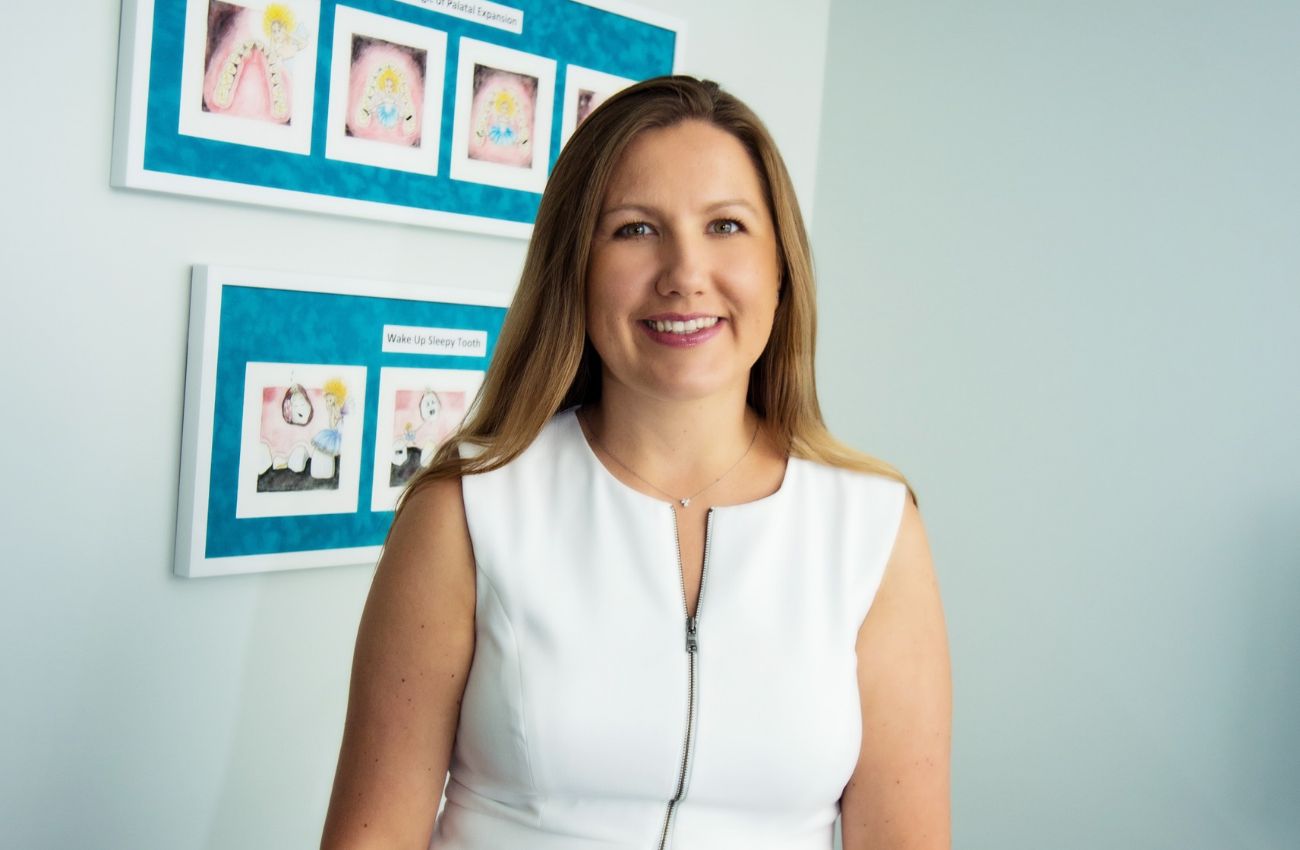
Dr. Marianna Evans of Infinity Dental Specialists in Newtown Square and Glen Mills treats crooked teeth as a sign of an underlying jaw development issue rather than a purely cosmetic problem. Her dual training in orthodontics and periodontics informs her treatment approach. She uses early jaw expansion, often starting at age three and a half, to address crowding, airway problems, and sleep issues at the source. This can mean less time in braces later on.
While most parents bring their child to an orthodontist because they want a straight smile, Dr. Evans wants parents to ask a different question first: Why isn’t there enough room for those teeth in the first place? It’s the question that has shaped her entire career. It’s also the reason families from across the region, and increasingly from around the country, seek out her practice.
A Rare Dual Specialty on the Main Line

Dr. Evans is one of a small number of clinicians in the world trained in two dental specialties at once: orthodontics, which straightens teeth and corrects bites, and periodontics, which treats the gums and bone that hold teeth in place. The University of Pennsylvania, where she trained, is the only school in the world that combines both into a single program, accepting just one person a year.
“This dual training allows me to really manage patients in a very comprehensive way,” Dr. Evans said. “That’s the mission of Infinity Dental Specialists, to treat patients from the foundation. We treat the complications, but we also reset the foundation, so it can last.”
That combination shapes how she looks at a child’s mouth long before she ever talks about braces. Dr. Evans and the rest of the Infinity Dental Specialists team bring that same foundation-first approach to every patient. A large share of her practice consists of very young children, some still in the baby-teeth stage. Many problems she treats in adults never should have happened in the first place. “These are a complication of not having a good foundation as a child,” she said.
Signs Main Line Parents Should Watch For
Dr. Evans, who also collaborates with Penn’s Sleep Surgery Department, has spent years studying the connection between a child’s jaw structure and their breathing and sleep quality. It’s a link most doctors and even many dentists aren’t trained to identify.
Here’s a scenario she sees often: a child isn’t sleeping well, so the first step is checking the tonsils and adenoids. Sometimes that fixes it. But sometimes the real issue is simpler and easier to miss: the jaw itself is just too small to comfortably hold everything inside it, including the tongue and the airway behind it.
Dr. Evans says it’s worth paying attention when a child shows one or several of these signs:
- A gummy or very narrow smile
- Crowding
- Crossbite
- An open bite
- Tongue ties
- Dark circles under the eyes
- Seasonal allergies that don’t seem to improve
- Restless, sweaty, or tossing sleep
- Anxiety
- ADHD
Dr. Evans has seen the same pattern play out in adults who never got evaluated as kids. Many end up at the plastic surgeon’s office instead of the orthodontist’s, trying to fix a gummy smile or a pronounced nasal hump without realizing the actual cause is a jaw that never developed the space it needed. “It could be fixed in a much healthier way if you address the jaw,” she said.
What Treatment Looks Like at Infinity Dental Specialists

A first visit at Infinity Dental Specialists starts with a conversation about family and environmental history and detailed photos. For kids who need it, she performs a low-radiation 3D scan, since a standard two-dimensional X-ray doesn’t show everything Dr. Evans needs to see.
For kids as young as three and a half, once their baby teeth are fully rooted, Dr. Evans often uses small, custom expanders as part of the practice’s broader range of orthodontic and periodontal services. She gently widens the upper jaw using baby teeth rather than waiting for permanent ones. That extra room gives permanent teeth space to come in properly and can open up the airway simultaneously.
Expansion isn’t only for children. Infinity Dental is one of the first orthodontic practices in the world to offer MARPE (miniscrew-assisted rapid palatal expansion), a non-surgical way to widen the upper jaw in adults. Patients travel from other states for the procedure, and other doctors come to the practice to train.
Treatment happens in short, deliberate bursts rather than one long stretch. Dr. Evans compared it to growth hormone therapy: instead of a daily shot, it’s more like a periodic boost. Roughly six months of active expansion, then a break to let the child keep growing naturally, timed to the biology of how their own teeth are erupting, sometimes followed by another round a year or two later.
“The reason your child has to spend more than two years in braces is because the jaw structures didn’t grow correctly,” she said. “We try to grow the bone to the maximum, so we don’t have to keep the kid in braces for a very long time. For some kids, it may even mean no braces or aligners.”
“Straight teeth sometimes are not necessarily healthy teeth,” Dr. Evans said. “We want the straight teeth and the nice smile to be a side effect of good structure, not the goal. The bite is not a weapon to break your tooth, which we often see in adults. The bite is a foundation for the tooth to outlive you.”

A Missing Piece: Myofunctional Therapy
There’s another piece of the puzzle Dr. Evans says gets overlooked almost as often as jaw structure itself: how a child uses the muscles of their face and mouth every day. It’s called myofunctional therapy, and she described it simply as physical therapy for the face.
“It’s the basic things that should happen naturally,” she said, “how to correctly hold your tongue, how to correctly hold your lips closed.” In a healthy mouth, the tongue rests against the roof of the mouth, lips stay gently closed, and breathing happens through the nose. But for a growing number of kids, those habits don’t form on their own, in part because of soft, processed diets and early bottle and pacifier use. Doctors call the pattern orofacial dysfunction.
“For your muscles, you can exercise, or you put your kids into sports to grow their muscles correctly,” Dr. Evans said. “But for your face, the exercise, the physical activity for your face, is food and nasal breathing.” Kids who mostly eat soft foods and breathe through their mouths never build up that muscle strength the way earlier generations did from chewing tougher foods. Dr. Evans estimated this pattern shows up in roughly eighty percent of the children she sees. “The face doesn’t grow correctly, the airway doesn’t develop correctly, and the teeth grow crooked,” she said.
Dr. Evans doesn’t provide myofunctional therapy herself, but builds it into a child’s overall treatment plan, working with trained therapists, including one in her own practice, and speech and language pathologists.
Why Jaws Are Shrinking in the First Place
Dr. Evans has researched this exact question, working with Penn’s anthropology department to study skulls from before the industrial era. Our ancestors’ jaws were noticeably more developed even just 400 years ago, a blink of an eye in evolutionary terms.
Her theory points to everyday shifts in how babies eat and grow. We now have more bottle feeding, pacifier use, shorter breastfeeding durations, and the rise of pureed, packaged baby food. “When a baby is breastfeeding, the tongue has to work so hard to get the milk out, and that pressure grows the upper jaw forward,” she explains. Bottle feeding relies on different muscles entirely. Purée pouches, which she called the “astronaut diet,” let kids swallow without ever having to chew. “It takes only one generation for this facial development to decline,” she said. “It doesn’t take evolutionary generations.”
She says she sees the pattern everywhere once you know to look for it. “Go to the swimming pool in the summer, or to the school,” she said. “Most of the kids have some kind of problem with the development of the teeth and the face compared to previous generations.”
Her research has drawn national attention, including a mention in journalist James Nestor’s bestselling book Breath. She has also appeared in documentaries exploring airway health.
Building a Culture of Prevention in Newtown Square and Glen Mills

For Dr. Evans and Infinity Dental Specialists, the bigger goal is changing how families and the dental field think about care. Orthodontists used to see a child with crowded teeth and simply pull some to make room, she says. They didn’t ask the more basic question: why isn’t there enough space in the first place? “Once the permanent teeth grow in, it’s more difficult to correct the problem,” she says. “We’re trying to build a culture of preventive dentistry and medicine.”
To do that, she has built a team that reaches beyond her own practice. She works with specialists at Children’s Hospital of Philadelphia and DuPont Hospital for Children. This includes allergists, ENTs, pulmonologists, and sleep specialists, since a child with a jaw and airway problem usually needs more than one kind of doctor to get properly diagnosed.
“It takes only one generation for this facial development to decline,” she said. “It doesn’t take evolutionary generations.” That’s the shift Dr. Evans is trying to get ahead of, one small jaw at a time.
Photos courtesy of Infinity Dental Specialists, as seen in the Main Line Parent Holiday Guide.
Infinity Dental Specialists supports the Main Line Parent Community. Collaborate with us!