Early Signs, Earlier Support: What Parents Should Know About Screening for Reading and Learning Differences
For Dyslexia Awareness Month in October, AIM shares what families should know about early signs of reading difficulty, what screeners can and cannot tell us, and why early support matters as Pennsylvania prepares to expand universal reading screening in schools

For many families, questions about learning begin with small observations: a child has trouble remembering letter sounds, rhyming is unusually hard, or reading a simple word takes tremendous effort.
None of these signs alone means a child has dyslexia or another learning difference. But families do not have to wait years before learning more about their child’s needs and strengths.
AIM’s story began 20 years ago when two mothers asked why their daughters were struggling to read — and why research was not reaching classrooms fast enough. That question still shapes AIM’s research-to-practice mission: understand what a child needs, use evidence to guide support, and act early.
Screening identifies risk. It does not diagnose.
That distinction is especially timely in Pennsylvania. Under Act 47, beginning in 2027–2028, students in kindergarten through third grade in covered public school entities will receive an approved universal reading screener three times each year.
A screener is a brief assessment used to identify children who may be at risk for reading difficulty and need additional instruction, monitoring or assessment. It is not a diagnosis or a special education evaluation. Instead, screening can identify children who may benefit from intervention and progress monitoring and, when appropriate, further assessment. A comprehensive evaluation is more extensive, bringing together multiple sources of information to understand why a child is struggling and determine whether a learning disability is present.
“It is important for families to understand that a screener cannot diagnose or give definitive information about a child’s skills,” says Julie Luzier, Director of Speech & Language Services at AIM Academy. “A screener is the initial step in indicating that there may be skills that are underdeveloped. Further testing and information is needed to make concrete recommendations about diagnoses or interventions.”
What signs can families look for?
Dyslexia is not simply reversing letters or “seeing words backward.” The International Dyslexia Association’s 2025 definition describes dyslexia as a specific learning disability involving persistent difficulties with accurate or efficient word reading and/or spelling. Early oral-language weaknesses can sometimes foreshadow later literacy challenges.
Depending on age, parents may want to take notice of persistent difficulty with:
● Learning rhymes
● Remembering letter names and sounds
● Hearing and working with sounds in words
● Learning or retrieving words
● Sounding out unfamiliar words
● Reading accurately and automatically
● Making expected progress despite appropriate instruction
Family history can also be important. No single sign proves a child has dyslexia. What matters is whether a pattern persists and how a child responds to instruction.
Why acting early matters
The purpose of identifying risk is not to label children earlier. It is to help them earlier.
Research shows that children who struggle with reading can make meaningful progress with targeted intervention. In one study, children who received intensive reading intervention in first or second grade made nearly twice the gains in foundational word-reading skills, relative to controls, as children who received the same intervention in third grade.
Support still matters later. But identifying risk early creates more time to build foundational skills before reading difficulty affects learning across subjects or a child’s confidence.
Pennsylvania’s law reflects that principle by connecting screening with intervention and progress monitoring. The National Center for Learning Disabilities similarly emphasizes pairing early screening with accurate identification and appropriate intervention.
“We know that the earlier a child is identified as at-risk for a learning difference, the earlier the support they receive, and in turn, more progress is gained over time” Luzier said. “Children’s language skills have a tremendous impact on their learning, and we understand that the toddler/preschool ages into the early grades are the time when a child’s language is developing rapidly. Waiting to see if a child ‘catches up’ has given a child time to fall behind, and risks missing the period of critical language development.”
Looking at the whole child
Reading is only one part of development. Oral language, speech, vocabulary, fine-motor and visual-motor skills can also shape learning.
That multidisciplinary perspective is part of AIM Academy’s approach. As the Philadelphia region’s largest school dedicated to students with language-based learning differences, AIM brings educators and specialists together to better understand how individual students learn.
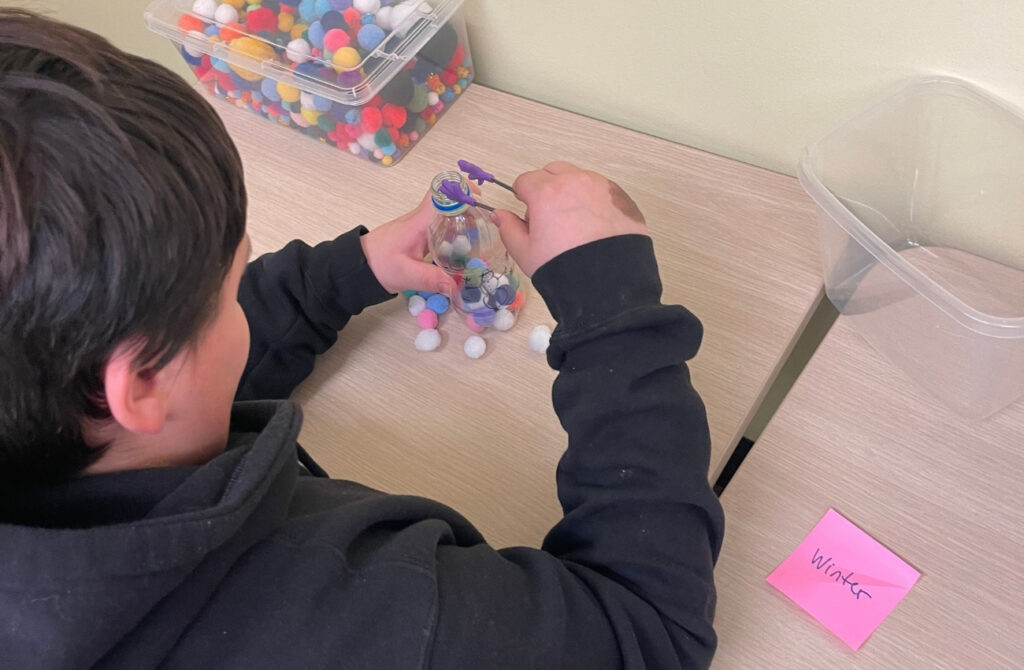
On October 9, AIM Academy will offer a limited free Early Learning Screening Pilot for kindergarten and first-grade children who are not AIM students. During the approximately one-hour session, an AIM Speech-Language Pathologist (SLP) and Occupational Therapist (OT) will look across early literacy and academic skills, language development, phonological awareness, vocabulary, and fine- and visual-motor skills. Families will receive a written summary of strengths, results and recommendations.
The screening is not diagnostic. Its purpose is to help families determine whether continued monitoring or additional assessment may be useful.
“An SLP and OT are uniquely positioned to understand the foundational skills of a child’s development that supports early reading and learning,” Luzier explained. “Learning starts with early language skills and cognitive processes that SLPs and OTs are trained to observe and understand. Each discipline brings an important perspective that works in conjunction with one another.”
Could a pediatric visit become another early checkpoint?
Researchers are also exploring whether a routine pediatric visit could identify risk sooner. On October 21, AIM Institute will host a free webinar with Dr. Shelley Gray and Dr. R.J. Risueño about a language and dyslexia screening questionnaire being developed for use by pediatricians.
A 2026 peer-reviewed study found promising preliminary results for identifying children who may be at risk for dyslexia or developmental language disorder. The researchers stress that the questionnaire supports risk identification and referral — not diagnosis — and requires further validation.
The work reflects an idea central to AIM: research has the greatest impact when it reaches people who can use it. Parents, educators, specialists and health-care providers can all help connect children with support sooner.
“October is Dyslexia Awareness Month, and it’s an important reminder that difficulty with reading should never be mistaken for a limit on a child’s potential,” said Annette Fallon, AIM Academy’s Head of School. “At AIM, we have seen what is possible when students are understood, supported early and taught in ways grounded in research. Children with dyslexia and other learning differences can achieve extraordinary outcomes in school and well beyond it.”
From concern to informed action
Screening can identify risk. Instruction and intervention can respond to it. Progress monitoring can show whether support is working. When difficulties persist, comprehensive evaluation can help explain why.
Families can also find free early-reading resources through Philadelphia’s Read by 4th.
During Dyslexia Awareness Month, the message is simple: early identification is not about labeling children sooner. It is about understanding their needs and connecting them with the right support sooner.
Photos courtesy of AIM Academy